Marriage is a new thing, it has existed only for a few weeks now, since June 26. And the church has nothing to say about it - or no more than, let's say, the color and layout of the new 20 dollar bill.
It is true that we previously used the word "marriage," but were wrong because actually there was no marriage then. What we thought we were referring to no longer exists. Obergefell also refers to "marriage" in the past, but actually is confused - there was no marriage before June 26.
The meanings of words have to do with how they are used. Obergefell makes clear that - well, marriage is wonderful! Ethically, Obergefell goes into overdrive in what it does. It stipulates that marriage has to do with our very highest values, the words used to describe it are superlative, like a kind of ethical summum. So it is clear that marriage is wonderful, marvellous, spectacular. Probably everyone should have a marriage, or get married, or do whatever it is to rise to these wonderful ethical heights of virtue and goodness.
However, it just isn't so clear what marriage is.
Now, it is true that the church in the past is guilty of using the word "marriage" to translate cognates of ἐκγαμίζω - and translated γυνή with "wife," and ἀνήρ as "husband." But it was wrong to do so, because marriage is - this wonderful ethical state which we should all rise to - and - we really aren't clear on what a husband or a wife are, but we are mere church people, and not in the business of creating new wonderful spectacular ethical states. This is a thing which the judiciary branch does.
The church does indeed need to have a translation of the word ἐκγαμίζω - but it is exceedingly clear that the word ἐκγαμίζω in Scripture is not this wonderful, ethical, virtuous thing we call marriage. It is very, very different.
So the church - because of the obvious problem of lack of clarity in the past - should draw some lines, like making clear that no one will be married in a church building, nor ministers participate in officiating such ceremonies.
This wonderful, spectacular ethical state is also likely to change quickly - as we come closer to Full Marriage Equality, which has been an enormously important goal of our society, and has been important in giving us marriage.
So the church can go about its business, and allow the state to create, regulate, and officiate over this wonderful new thing it has given us.
Thus, the importance of recognizing that marriage is a new, wonderful thing.
Wednesday, July 15, 2015


Monday, June 1, 2015
Jacob was a gigolo: Genesis 30, disorder, and promise in a Patriarch's household
[ This blog posting began as a comment, which was in danger of hijacking the thread it was posted into. I do hope someday to revise this, but many will probably already find it interesting as it stands. This is posted shortly after revelations regarding the Duggar family - and a few other stories in the news and op eds which, I believe, make this material in Genesis of particularly timely value for reflection. The subject matter is darkly ironic, and rather frankly insulting. I would encourage anyone commenting on this material to pray first; as ugly as some themes initially appear, it is of paramount importance that we remain respectful to the self-revelation of He who is revealed in Scripture, in the bountifully and wonderfully odd ways He is sometimes revealed. ]
Jacob's life is profoundly marked by "struggle-of-two" stories - the struggles which took place with his own brother, and of course the struggle which took place at the area which Jacob later called "Pniel." And there is yet another.
While Jacob is sent away to his uncle Laban's, there is another "struggle-of-two" story - his two wives who contend over his body for their own fertility. A culminating moment is when Leah goes out in the field to meet him after his day's work and insults him doubly - or actually even triply - 1) revealing that his eldest son has been harvesting aphrodisiacs (mandrakes) - some sort of darkly strange womany seduction/fertility tool - 2) and also that his husbandly services have been purchased as if he were a gigolo. (This oldest son, Ruben, will later have relations with Bilhah, his father's concubine). 3) The third, implied insult is that his wife Rachel is pimping him out, and controlling one of the most vitally important domestic matters (the means of having offspring) by selling him to acquire his own son's aphrodesiacs. Jacob himself is bandied about, bought and sold, as if he were a mere mandrake - an ingredient of the fertility process - in a family situation which borders on the incestuous, if not worse - with Jacob's own son in some way involved in this sex-trade-for-sex-paraphernalia. It is indeed like a kind of "libidinal economy," in a very literalistic sense, with the circularity implicit in the notion of oikonomia and economy - meaning simultaneously economic exchange, and household order.
This would, I believe, have been read by the very first readers of the book of Genesis as a household in grave disorder - a household where women agonistically control a husband who may not even determine for himself where he spends the night, or where his seed might fertilize.
We read later of further disorder in his chosen and favored spouse, Rachel, stealing her father's hearth idols (probably primarily fertility fetishes), and then secreting them away under herself, protected by imagined issue of blood from her overflow / excess / unused fertility - for the Jews, a very dark, secretive thing to be burned even.
Jacob's wives are centered upon what Abraham has been promised - offspring - but then in a manner so distant from God's intention. The text is curiously silent about this situation which for the first readers of Genesis must have seemed simultaneously immoral and yet circus-like. There is shame, there is humor, there is irony - and it is all left along the sidelines as the narrative progresses silently, yet relentlessly further.
God is sovereign. And His promise to Abram is accomplished even through Bilhah, Zilpah, and this darkly comedic and disordered domestic situation.
Jacob's story is one of quiet comedy, and profound blessing despite the chaos, disorder, and sin surrounding him. Look also at his wacky pre-genetic-age experiment with the goats. Yet God blesses Jacob, despite his trying to MacGyver God's promises into being.
________________________________
Look at us now - the way our households are so focused on children and child upbringing, that we consume all resources around us and leave such a great swathe of the American nation in poverty or in prison, with "education" nonetheless becoming a strange dumbed-down area where again we are competing over a vision having to do with sexuality and gender. It is a domestic situation resulting in profound injustice for both the men and the women, and of course - also the children.
But God is sovereign, and He delivers on His promises - even though we must sometimes wait (which implies: having patience). Jacob had to wait many, many years. His wives did not want to wait. And at times, Jacob did not want to wait either.
My prayer here is that we will learn patience, that we will deal justly, and that God will return a proper focus upon our domestic situations, despite the wacky things Christians in particular seem to have done with "family values" teachings and practices.
__________________________________
This makes me also think of the terrible confusion surrounding the miracles which Christ performed - the wonderful gifts, and promise which could be seen within - but then a strange outside-ness, a sense of appearance and spectacle - Christ's words, "do not go and tell the village" - the people becoming confused, wanting what they should not want, very few (if any!) seeing Christ for who He is. But Christ continues anyway - despite the chaos, the unfaithfulness of the people, the misinterpretations, and the appropriations (the taking of His signs for their own purposes). He modifies his ways of dealing with the people, it seems (no longer even bothering to ask them not to go tell the village) - but he continues to engage in His ministry of love nonetheless. He does not try to bring more attention to himself through little gimmicks that "those folks will just love!!!" - the times that He speaks of the "agora" - (equivalent of our commercial setting, including media) - at least on one occasion, not very positive!!! For He could have most certainly peppered His words with little stories and memes floating around the agora at the time (and now, I am falling into repetition myself).
The seeds, the harvest, the offspring ... it is so chaotic. It is beset with so much sin. The dissemination, the promised people ... it is not a "tidy" thing. But the promise is brought about nonetheless, without clever little tricks, and regardless of the connivances of those who have pledged troth to Him.
___________________________________________
Fast-forward a bit more than a thousand years after the coming of Christ, into the middle ages. Richard of St. Victor uses the figure of Rachel for describing human reason, and (and very interestingly for the modern perspective - the "glue" of consciousness, or the imagination). Reason is Rachel in her tent. And the imagination is Bilhah, her maidservant - who comes in and out of the tent, bringing Rachel what she needs. http://www.ccel.org/ccel/gardner/cell/files/cell.html#Heading3
A tent is already a dark place, shielding the inside from the sun and light around. It could be that Richard of St. Victor sees consicousness as a a womb, with the strong associations Rachel has with the womb. But to add to this, the primary womb - Rachel - needs to make use of the services of another woman who is primarily associated with her womb - Bilhah, as being a surrogate mother is her most important function in this narrative.
The "seeds" of chaos, disruption, and unfaithfulness (with Bilhah, a perceived necessary unfaithfulness) are here in this description of consciousness and the imagination.
This is also the case when it comes to what is inside the tent, other than Rachel. We have little knowledge of the contents of the tent, other than the idols (or "images") which were probably fertility gods, which she had stolen from her father.
Rachel is the sister of Leah - who for St. Victor is the affections - whose maidservant is Zilpah, "ever drunken and thirsty" - who is sensuality. Bilhah, or the imagination, is "a great jangler."
"By Jacob is understanden God" - "so man's soul through light of knowing in the reason, and sweetness of love in the affection, is spoused unto God." And such a complicated and unfaithful spousal relation that is.
[ note for further updates - this is rather "dark thinking." What should be added is how this picture of human fallenness is perhaps incomplete. What we know of human reason is like Rachel and Bilhah - though Rachel was never compelled into unfaithfulness, and Bilhah would have avoided her most famous unfaithfulness if it hadn't been for Ruben's promptings - Ruben being this first son of sensuality (Leah), and the procurer of mandrakes.
Jacob's life is profoundly marked by "struggle-of-two" stories - the struggles which took place with his own brother, and of course the struggle which took place at the area which Jacob later called "Pniel." And there is yet another.
While Jacob is sent away to his uncle Laban's, there is another "struggle-of-two" story - his two wives who contend over his body for their own fertility. A culminating moment is when Leah goes out in the field to meet him after his day's work and insults him doubly - or actually even triply - 1) revealing that his eldest son has been harvesting aphrodisiacs (mandrakes) - some sort of darkly strange womany seduction/fertility tool - 2) and also that his husbandly services have been purchased as if he were a gigolo. (This oldest son, Ruben, will later have relations with Bilhah, his father's concubine). 3) The third, implied insult is that his wife Rachel is pimping him out, and controlling one of the most vitally important domestic matters (the means of having offspring) by selling him to acquire his own son's aphrodesiacs. Jacob himself is bandied about, bought and sold, as if he were a mere mandrake - an ingredient of the fertility process - in a family situation which borders on the incestuous, if not worse - with Jacob's own son in some way involved in this sex-trade-for-sex-paraphernalia. It is indeed like a kind of "libidinal economy," in a very literalistic sense, with the circularity implicit in the notion of oikonomia and economy - meaning simultaneously economic exchange, and household order.
This would, I believe, have been read by the very first readers of the book of Genesis as a household in grave disorder - a household where women agonistically control a husband who may not even determine for himself where he spends the night, or where his seed might fertilize.
We read later of further disorder in his chosen and favored spouse, Rachel, stealing her father's hearth idols (probably primarily fertility fetishes), and then secreting them away under herself, protected by imagined issue of blood from her overflow / excess / unused fertility - for the Jews, a very dark, secretive thing to be burned even.
Jacob's wives are centered upon what Abraham has been promised - offspring - but then in a manner so distant from God's intention. The text is curiously silent about this situation which for the first readers of Genesis must have seemed simultaneously immoral and yet circus-like. There is shame, there is humor, there is irony - and it is all left along the sidelines as the narrative progresses silently, yet relentlessly further.
God is sovereign. And His promise to Abram is accomplished even through Bilhah, Zilpah, and this darkly comedic and disordered domestic situation.
Jacob's story is one of quiet comedy, and profound blessing despite the chaos, disorder, and sin surrounding him. Look also at his wacky pre-genetic-age experiment with the goats. Yet God blesses Jacob, despite his trying to MacGyver God's promises into being.
________________________________
Look at us now - the way our households are so focused on children and child upbringing, that we consume all resources around us and leave such a great swathe of the American nation in poverty or in prison, with "education" nonetheless becoming a strange dumbed-down area where again we are competing over a vision having to do with sexuality and gender. It is a domestic situation resulting in profound injustice for both the men and the women, and of course - also the children.
But God is sovereign, and He delivers on His promises - even though we must sometimes wait (which implies: having patience). Jacob had to wait many, many years. His wives did not want to wait. And at times, Jacob did not want to wait either.
My prayer here is that we will learn patience, that we will deal justly, and that God will return a proper focus upon our domestic situations, despite the wacky things Christians in particular seem to have done with "family values" teachings and practices.
__________________________________
This makes me also think of the terrible confusion surrounding the miracles which Christ performed - the wonderful gifts, and promise which could be seen within - but then a strange outside-ness, a sense of appearance and spectacle - Christ's words, "do not go and tell the village" - the people becoming confused, wanting what they should not want, very few (if any!) seeing Christ for who He is. But Christ continues anyway - despite the chaos, the unfaithfulness of the people, the misinterpretations, and the appropriations (the taking of His signs for their own purposes). He modifies his ways of dealing with the people, it seems (no longer even bothering to ask them not to go tell the village) - but he continues to engage in His ministry of love nonetheless. He does not try to bring more attention to himself through little gimmicks that "those folks will just love!!!" - the times that He speaks of the "agora" - (equivalent of our commercial setting, including media) - at least on one occasion, not very positive!!! For He could have most certainly peppered His words with little stories and memes floating around the agora at the time (and now, I am falling into repetition myself).
The seeds, the harvest, the offspring ... it is so chaotic. It is beset with so much sin. The dissemination, the promised people ... it is not a "tidy" thing. But the promise is brought about nonetheless, without clever little tricks, and regardless of the connivances of those who have pledged troth to Him.
___________________________________________
Fast-forward a bit more than a thousand years after the coming of Christ, into the middle ages. Richard of St. Victor uses the figure of Rachel for describing human reason, and (and very interestingly for the modern perspective - the "glue" of consciousness, or the imagination). Reason is Rachel in her tent. And the imagination is Bilhah, her maidservant - who comes in and out of the tent, bringing Rachel what she needs. http://www.ccel.org/ccel/gardner/cell/files/cell.html#Heading3
A tent is already a dark place, shielding the inside from the sun and light around. It could be that Richard of St. Victor sees consicousness as a a womb, with the strong associations Rachel has with the womb. But to add to this, the primary womb - Rachel - needs to make use of the services of another woman who is primarily associated with her womb - Bilhah, as being a surrogate mother is her most important function in this narrative.
The "seeds" of chaos, disruption, and unfaithfulness (with Bilhah, a perceived necessary unfaithfulness) are here in this description of consciousness and the imagination.
This is also the case when it comes to what is inside the tent, other than Rachel. We have little knowledge of the contents of the tent, other than the idols (or "images") which were probably fertility gods, which she had stolen from her father.
Rachel is the sister of Leah - who for St. Victor is the affections - whose maidservant is Zilpah, "ever drunken and thirsty" - who is sensuality. Bilhah, or the imagination, is "a great jangler."
"By Jacob is understanden God" - "so man's soul through light of knowing in the reason, and sweetness of love in the affection, is spoused unto God." And such a complicated and unfaithful spousal relation that is.
[ note for further updates - this is rather "dark thinking." What should be added is how this picture of human fallenness is perhaps incomplete. What we know of human reason is like Rachel and Bilhah - though Rachel was never compelled into unfaithfulness, and Bilhah would have avoided her most famous unfaithfulness if it hadn't been for Ruben's promptings - Ruben being this first son of sensuality (Leah), and the procurer of mandrakes.
Thursday, May 21, 2015
Church in a Honey Boo-Boo Moment of History
[This is a comment I left to a Facebook posting with a question on appropriateness, with attached video of a 4-year-old-ish child dancing in front of a congregation to an upbeat Christian worship song "He's The Light" - I don't have time for much more than this, but wanted to share more widely. I'm not including the video, because I do not want to expose the parents or the child unnecessarily - I edited my comment to request that the rather critical posting in the facebook not be shared with the original video poster.
The very, very cute 4 year old is dancing and pointing up - "He's the Light!!" Nothing particularly noteworthy nor different from what we see in so many churches in America. This is not aimed at the family that posted the video - rather, "this is us," this is American Christianity]
-----------------------------------
Since this is a child, and we don't know the context - it is very, very difficult for us to tell what is going on (esp. in the mind and spirit of the child).
From what I remember of childhood and "public behavior," performance, acting - I can say this: It is very very easy for a child to become swept away with the reactions of others, esp. to "cutesiness." I can't really think of any Biblical injunctions against "cutesiness" per se - but at the same time, that does NOT mean that this is not a potential problem! It is very, very, very true that almost all Americans get really carried away with "cute children," and if you put a child doing something cute almost everywhere - we are almost socially compelled to say, "Oh, how wonderful, how cute!" and to ignore almost all of the potential consequences as "not our business."
However, from what I remember about public situations as a child, when many people were watching me - I would say this: It is much, much, much better for kids to praise God in a group, where no one of them is somehow "shining" more than the others in getting attention - because this attention alone can get the child thinking about all sorts of things that are very very different from praising God. If you want your kids to do some kind of cute stuff in a solo act - then by all means, have them sing a Spice Girls song or something like that - *unless* you have very, very seriously discussed and prepared them for what is going on, and you are confident that they are ready for what they are going to do - and you also have some kind of discussion with the kid afterward about what went on.
As a kid - I know I had all kinds of other things going through my mind, I was doing a little bit of praising God, but mostly it was putting on a show to please the adults. It is not bad to please adults! But when a child gets to an age of a little bit more self-consciousness - this can become difficult! The question arises - "OKAY - what is happening here? Is my 'churchiness' simply a cute little show to please mom and dad and the other church-goers? Why did I do that little show X years ago - and why am I doing it now?" A kid probably won't even ask their parents this question - they will probably just try to dissociate themselves from that kind of activity in general, because they find it inauthentic. "BUT IT IS SOOOOO CUUUTE!!!!" - this is not the kind of response that is going to convince a 14 year old kid that doing this type of thing is honest, good, is praising God - it is rather the opposite of what a lot of them aspire to.
It boggles my mind as to why we continue to do this type of thing with children / to children. It seems to me like a sure-fire recipe for disaster in the development of spirituality in children. Children begin to rebel against this - *Of course they do* !!! Parents, I have seen them do this in a church Sunday school program - where the highschoolers did not, did not, did not want to do skits - in fact, they wanted to study the Bible instead. And what did the Sunday School leadership mandate??? They *had* to do the skits. And since the highschoolers were so self-conscious, they wanted to do these silly skits as well and perfectly and thought-out as they could. So we spent just about ALL of our time doing these SILLY skits that the kids HATED but then went up on stage and dutifully performed because their parents somehow wanted to still have these cutesy moments where they felt like their kids .... I dunno??? The Sunday School teachers told the youth pastor about this problem - and still, we had these skits mandated.
This was so utterly ironic. The kids, in hindsight I think, could "see" what was happening - how they were being cutesified for their parents, publicly, by doing these skits - and they realized it was a waste of time, and they wanted to be doing what kids should be doing in Sunday School class - studying the Bible! But - well, no, parents pay for the church and not the kids - so the kids had to do the cutesy stuff. I am still rather awestruck at how ironic this was, and in other ways, how I have been a rather willing participant in the cutesifying of church in such a way that makes church exceedingly unappealing except for a particularly "duty-bound" type of advocate of cutesy church - which oddly enough, seems to be most Americans who have kids! Somehow, this seems to be a thing which almost all parents believe in. And so sad they can't believe their kids just want to study the Bible, and engage in thoughtful conversation, but instead want to do all this cutesy-kid stuff. For me - it marked a very important point in my dissociation from "Evangelicalism" - since there is more to life than movies, skits, and other kinds of "kid-stuff" - or at least, I want there to be (though it somehow seems to be increasingly impossible - but this is not a direct fault of the kids, it is a very indirect thing which has to do with how adult culture is in an odd symbiosis with kid culture in America - or maybe rather, imagined kid culture - which then ends up conditioning adults, and indirectly conditioning kids).
Do you parents really need to cherish a cutesy churchy moment so badly that you are willing to blind yourselves to the normal pattern of development, of what just about any healthy growing mind would begin to ask itself? And then churches so reliant on the money of such parents that they are more or less forced into this, beyond better judgment?
What does this say about the generations of people in church, and worship?? Why is it that we continue to think that kids want kiddy-kiddy stuff, and that it's the kiddy-kiddy stuff all out-and-proud-and-public that is gonna save the church? This has gotten ridiculous, it is like church is going through a Honey Boo Boo moment of history.
The very, very cute 4 year old is dancing and pointing up - "He's the Light!!" Nothing particularly noteworthy nor different from what we see in so many churches in America. This is not aimed at the family that posted the video - rather, "this is us," this is American Christianity]
-----------------------------------
Since this is a child, and we don't know the context - it is very, very difficult for us to tell what is going on (esp. in the mind and spirit of the child).
From what I remember of childhood and "public behavior," performance, acting - I can say this: It is very very easy for a child to become swept away with the reactions of others, esp. to "cutesiness." I can't really think of any Biblical injunctions against "cutesiness" per se - but at the same time, that does NOT mean that this is not a potential problem! It is very, very, very true that almost all Americans get really carried away with "cute children," and if you put a child doing something cute almost everywhere - we are almost socially compelled to say, "Oh, how wonderful, how cute!" and to ignore almost all of the potential consequences as "not our business."
However, from what I remember about public situations as a child, when many people were watching me - I would say this: It is much, much, much better for kids to praise God in a group, where no one of them is somehow "shining" more than the others in getting attention - because this attention alone can get the child thinking about all sorts of things that are very very different from praising God. If you want your kids to do some kind of cute stuff in a solo act - then by all means, have them sing a Spice Girls song or something like that - *unless* you have very, very seriously discussed and prepared them for what is going on, and you are confident that they are ready for what they are going to do - and you also have some kind of discussion with the kid afterward about what went on.
As a kid - I know I had all kinds of other things going through my mind, I was doing a little bit of praising God, but mostly it was putting on a show to please the adults. It is not bad to please adults! But when a child gets to an age of a little bit more self-consciousness - this can become difficult! The question arises - "OKAY - what is happening here? Is my 'churchiness' simply a cute little show to please mom and dad and the other church-goers? Why did I do that little show X years ago - and why am I doing it now?" A kid probably won't even ask their parents this question - they will probably just try to dissociate themselves from that kind of activity in general, because they find it inauthentic. "BUT IT IS SOOOOO CUUUTE!!!!" - this is not the kind of response that is going to convince a 14 year old kid that doing this type of thing is honest, good, is praising God - it is rather the opposite of what a lot of them aspire to.
It boggles my mind as to why we continue to do this type of thing with children / to children. It seems to me like a sure-fire recipe for disaster in the development of spirituality in children. Children begin to rebel against this - *Of course they do* !!! Parents, I have seen them do this in a church Sunday school program - where the highschoolers did not, did not, did not want to do skits - in fact, they wanted to study the Bible instead. And what did the Sunday School leadership mandate??? They *had* to do the skits. And since the highschoolers were so self-conscious, they wanted to do these silly skits as well and perfectly and thought-out as they could. So we spent just about ALL of our time doing these SILLY skits that the kids HATED but then went up on stage and dutifully performed because their parents somehow wanted to still have these cutesy moments where they felt like their kids .... I dunno??? The Sunday School teachers told the youth pastor about this problem - and still, we had these skits mandated.
This was so utterly ironic. The kids, in hindsight I think, could "see" what was happening - how they were being cutesified for their parents, publicly, by doing these skits - and they realized it was a waste of time, and they wanted to be doing what kids should be doing in Sunday School class - studying the Bible! But - well, no, parents pay for the church and not the kids - so the kids had to do the cutesy stuff. I am still rather awestruck at how ironic this was, and in other ways, how I have been a rather willing participant in the cutesifying of church in such a way that makes church exceedingly unappealing except for a particularly "duty-bound" type of advocate of cutesy church - which oddly enough, seems to be most Americans who have kids! Somehow, this seems to be a thing which almost all parents believe in. And so sad they can't believe their kids just want to study the Bible, and engage in thoughtful conversation, but instead want to do all this cutesy-kid stuff. For me - it marked a very important point in my dissociation from "Evangelicalism" - since there is more to life than movies, skits, and other kinds of "kid-stuff" - or at least, I want there to be (though it somehow seems to be increasingly impossible - but this is not a direct fault of the kids, it is a very indirect thing which has to do with how adult culture is in an odd symbiosis with kid culture in America - or maybe rather, imagined kid culture - which then ends up conditioning adults, and indirectly conditioning kids).
Do you parents really need to cherish a cutesy churchy moment so badly that you are willing to blind yourselves to the normal pattern of development, of what just about any healthy growing mind would begin to ask itself? And then churches so reliant on the money of such parents that they are more or less forced into this, beyond better judgment?
What does this say about the generations of people in church, and worship?? Why is it that we continue to think that kids want kiddy-kiddy stuff, and that it's the kiddy-kiddy stuff all out-and-proud-and-public that is gonna save the church? This has gotten ridiculous, it is like church is going through a Honey Boo Boo moment of history.
Thursday, August 9, 2012
Beck's New Revolutionary Album
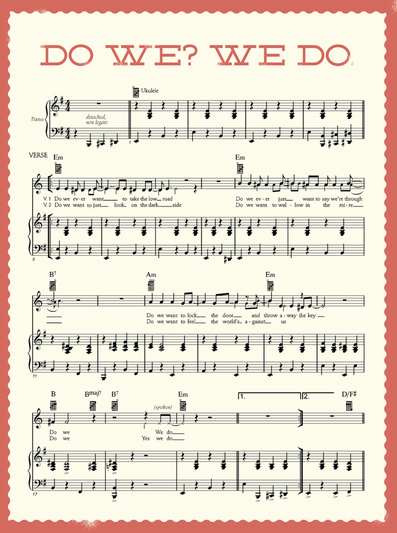
For those who are speed-reading: Beck's new album will apparently contain no recorded music. Yes, you read that correctly.
Here: a McSweeny's article on his forthcoming (album?) Song Reader.
I have recently been reading Plato, Aristotle, others on music - there are many indicators that the Hellenist (Greek) understanding of music would have been exceedingly important in the culture of the Palestine where Jesus was brought up, and conducted His ministry. I even believe that at one point, His own words refer indirectly to some of the issues discussed at that time regarding music, education, character, and the divine.
One of the things we have lost from the pre-Romantic understanding of music is the way that music is active with regards to the listener - that it moves the heart and mind of the listener, but this itself is also dependent upon the listener's own activity (and cultivation).
I.e., music ALWAYS implies doing something yourself. Plato and Aristotle actually thought it best to avoid as possible professional musicians - simply because this meant not making the music one's self.
In modern times, we essentially have a problem of a market of extraordinarily lazy music listeners who lack the imaginative powers to put together (synthesize) interesting musical developments in their minds. As Bernstein said, we all hear much too much music, and listen to very little music. This cultivates a habit of non-active listening.
What Beck has done here is very much like turning us back to Plato and Aristotle when we consider our relationship to music.
BRAVO! This is not only a musical mind - it is a profoundly deep mind in the consideration of how we relate ourselves to music, and how music effects us over time - even over multiple generations.
Up until sometime in the middle ages - the word "musician" was not even applied to singers and instrumentalists - it was applied exclusively to thinkers who could imaginatively grasp what music was doing - like Boethius.
So Beck here is being a musician in a very profound sense.
I found this link thanks to Eric Whitacre - a composer who himself is very much a musical mind in the older sense, with his Virtual Choir (and who has done such incredible things as setting Paradise Lost to music).
If Western culture is to re-gain an ability to listen to music, we probably first need to do something like this - very simply, more people making music, and less people hearing music in the background. And after a while, with an audience that's more capable of listening to interesting music (instead of music that's mostly intended to be a kind of background or sound-track), it might again become possible for truly fantastic music to find an audience that's more than a tiny, highly select group of individuals. As Aristotle put it - good musical education is so important, it's something that should belong to everyone.
Thursday, May 10, 2012
Occupy and the Unasked Question: Conspicuous Consumption
 |
| Thornstein Veblen |
"We ought to ask of economics the same question of that we ask with regards to any other moral issue: how it fosters or frustrates human flourishing."
It is true that the Occupy movement is difficult to deal with - given that its critique of society seems so vapid and monolithic - and reverberations in the press don't seem to be generating anything deeper, either.
Nonetheless - it is a good thing to examine our economic and political system, with the aim of arriving at more poignant questions, new avenues for dialogue, and uncovering our blindness to issues that don't usually grab our attention.
And the three authors of this First Things blog post do a great job at summarizing the social ills that accompany a high degree of economic inequality between classes.
I suppose though that it is also worth asking: "Is a society based on liberal capitalism which has embraced conspicuous consumption as an ideal to the degree that America has, not predisposed toward fostering such economic inequality?" This is a question of rather serious magnitude and would take a great deal of thought, research, and unpacking. But let us first consider one element of this question - that of conspicuous consumption.
My own "take" here is more or less this: that conspicuous consumption is the greatest enemy, greater than the economic inequality itself. In nearly all societies, power has been held by a few - whether they be aristocracy, elected officials, or the wealthy. But we rightly expect this power to be exercised wisely and justly. We have been aware since ancient times that mob rule is one of the very most painful and unjust forms of government.
When the wealthy invest their wealth in the creation of jobs - e.g., in farms, factories, shops, corporations, stocks ... they are investing wisely and justly, and re-distributing wealth in a productive manner for the public good.
When they invest their wealth in ridiculously large houses, insanely expensive sports cars, boats, fashion accoutrements etc. etc., though there is some initial employment, the house or sports car is economically speaking a "dead end" - it does not further employment or the public good.
What is particularly ugly are the social effects - envy and jealousy, social stratification which has little to do with merit or talent, and widescale loss of trust in employers and governments for the portion of work which does not go toward feeding, housing, and educating, but is rather tied up in such an economic dead end with its toxic effects on society.
Wednesday, November 30, 2011
Schubert Holy Holy Practice
Videos for practicing Schubert's "Holy Holy" (from the Deutsche Messe) in parts, intended especially for congregational singing:
Soprano
(alto, tenor, and bass follow)
Doxology Practice
Sheet music- Link
Videos for congregational singing practice of the Doxology (set to the "old 100th"):
Videos for congregational singing practice of the Doxology (set to the "old 100th"):
Soprano
(alto, tenor, and bass follow)
Subscribe to:
Posts (Atom)